Content tagged with: php
Learn how to work with Selenium 2 directly within PHPUnit. For those unfamiliar, Selenium gives us an easy way to automate the browser. This makes it perfect for writing user acceptances tests.
Learn how to make your Zend Framework 2 application fly using ESI (Edge Side Includes) and Varnish web application accelerator. In today’s web applications, personalized sections and data that is frequently updated mean full-page caching is rarely an option. Using ESI and Varnish, we will cache a generic site layout for as long as possible, and have it request personal data and frequently updated data in separate requests. This will result in much better perceived performance and much less load on application servers.
This panel of Shawn Stratton, Evan Coury, Mike Willbanks and Matthew O’Phinney will present information about three applications built using Zend Framework 2 during it’s early development and how their feedback help influence and shape the direction of the development. Come see how these early adopters feel about the final ZF2, using open source early and how this active participation helps shape ZF2.
This is a short talk that discusses the various differences between extensions and packages. It provides the developers and audience members with assorted options and choices when it comes to writing distributable code.
Javascript is ubiquitous. Node.js tries to be the next PHP but it just can’t. This talk presents an experiment that freaked out many people: NodePHP. NodePHP is an inline PHP server running on Node.js During the talk, the speaker goes over what “node-php” is and more importantly how is that possible or why would anyone do this. Towards the end, he shows how the two technologies can be coopetitors rather than competitors.
Learn again to use PHP data structures appropriately, leaning closer on the way to employ arrays, the SPL and other structures from PHP extensions as well. We all have certainly learned data structures at school: arrays, lists, sets, stacks, queues (LIFO/FIFO), heaps, associative arrays, trees, … and what do we mostly use in PHP? The “array”! In most cases, we do everything and anything with it but we stumble upon it when profiling code.
This tutorial shows how to create an extremely simple MVC boilerplate for small projects which don’t require a massive framework, like CodeIgniter or CakePHP. You will see how to build such a solution in ten minutes or so.
This talk covers the creative process, our dual CPU-brain and the cognitive skills needed for successful programming. As an added bonus we will also investigate why doing nothing does not mean you are not working.
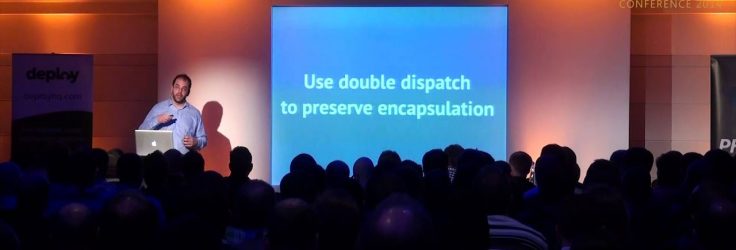
The way the code of an application is organized greatly influences its maintainability, extendability and testability. Finding flaws in your object-oriented design as early as possible can therefore make the difference between an awesome application and a not so good one. Luckily there are a lot of indicators to look out for while you are coding, telling you that you should probably consider refactoring – often without even looking at your actual code!
Tis presentation details how to incorporate security checks into the software development process for PHP applications. It also steps through the implementation and caveats of a security audit.


Twitter
Facebook
RSS Feed